The Lighthouse-excursion dispute
To the LighthouseThe Lighthouse-excursion dispute is the family’s first, defining disagreement over whether James may hope to visit The Lighthouse. Mrs Ramsay leaves the possibility open, while Mr Ramsay declares the weather will make the journey impossible. More than a forecast, the exchange brings competing forms of care into view: he treats hard facts as a preparation for life, while she resists turning uncertainty into a premature disappointment. The postponed outing becomes a measure of how words, expectations, and the natural world can shape a moment long after it has passed.
The Promise and Its Stakes
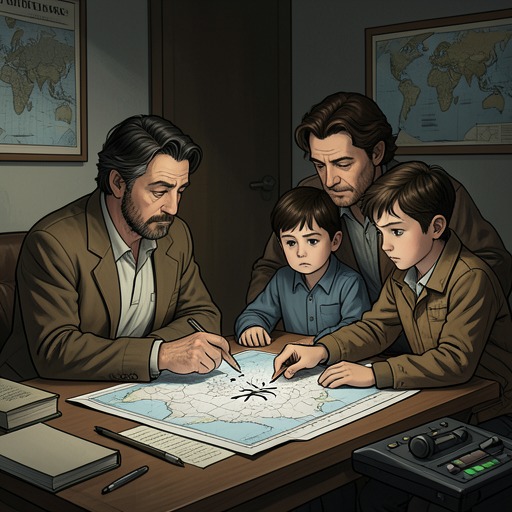
Mrs Ramsay tells James that the trip can happen if the following day is fine, adding that he will have to rise early. To him, her conditional answer already carries the force of a promise. As he cuts pictures from the Army and Navy Stores catalogue, even the picture of a refrigerator seems transformed by the expedition he imagines. His excitement shows how a future possibility can colour the ordinary present: the outing is not merely a destination, but an anticipated joy that gathers meaning in advance.
The outing is also linked to Mrs Ramsay’s practical concern for the Lighthouse keeper’s family. She knits a reddish-brown stocking for the keeper’s young son, who has a hip condition, and plans to send old magazines, tobacco, and whatever useful odds and ends she can find. Her account of life on an isolated rock emphasizes the keeper and his family’s confinement, especially during storms. The proposed visit therefore belongs to a wider pattern of Mrs Ramsay’s care: she imagines other people’s privations and looks for modest comforts she can provide.
Forecast, Conflict, and Reassurance
Mr Ramsay counters his wife’s conditional hope with a blunt prediction that the weather will not be fine. His certainty rests on the barometer and the west wind, which Charles Tansley also identifies as coming from the direction least suitable for landing at The Lighthouse. When Mr Ramsay repeats that there is no chance of going the next day, Mrs Ramsay points out that the wind may change. He reacts angrily to what he sees as an irrational refusal to accept the facts, and regards her hopeful suggestion as giving the children false expectations.
The disagreement is sharpened by the difference between factual accuracy and emotional consequence. Mr Ramsay believes that children should learn that life is difficult and that truth should not be altered for their comfort. Mrs Ramsay, meanwhile, experiences his bluntness as a breach of human consideration. Yet the conflict does not settle into simple opposition: after his anger, he offers to ask the Coastguards if she wishes. She says she is willing to take his word and concludes that there is no need to prepare sandwiches. His return to her side, and her readiness to accept his judgment, turn the dispute into a moment of marital friction followed by reassurance rather than a final rupture.
Tansley’s repeated reminder that the family will not go to The Lighthouse extends the disappointment beyond the parents’ exchange. Although he tries to soften his voice out of deference to Mrs Ramsay, his insistence keeps James’s frustrated expectation in view. Mrs Ramsay finds the repetition objectionable, but does not allow the others to mock Tansley. The argument thus also reveals her role as protector of guests, even while she disagrees with what they say and attends to the effect their words have on her son.
The Evening Light and the Remembered Refusal
That evening, Mrs Ramsay reads to James despite growing anxious about the delayed return of Paul, Minta, and Andrew. She finishes the story without letting her worry alter her voice. As James watches her, she closes the book and sees that the story’s hold on him has given way to wonder. Across the bay, the light of The Lighthouse is visible, passing over the waves in two quick strokes followed by a longer steady one. The real light appears at the moment the imagined journey has become a denied one: the destination is present to sight, but not available as tomorrow’s excursion.
Mrs Ramsay anticipates James asking whether they are going the next day and knows she will have to tell him that his father says they are not. Mildred’s arrival interrupts the moment, but James looks back as he is carried out, and Mrs Ramsay believes he is still thinking about the refusal. She gathers together the catalogue pictures he has cut out, including a refrigerator, a mowing machine, and a man in evening dress, and reflects that children do not forget. For her, the dispute makes the stakes of adult speech plain: a small decision about weather and travel can become a lasting memory because of the hope first raised and then withdrawn.
Recurrence, Nature, and Loss
The postponed outing is not resolved by a simple change in weather or by the immediate fulfilment of James’s wish. The narrative instead returns to its central terms—expectation, uncertainty, and the limits of human control—across a longer span of time. At moments, the natural world seems to offer a composed image: a hare, a falling wave, and a rocking boat briefly appear as a distinct whole. But this calm is temporary; hail and disorder obscure it again. The later reflection undercuts any easy belief that nature supplies a stable answer to human hopes.
Storms and changing seasons likewise resist the idea that the world will arrange itself around human feeling. Wind and waves unsettle the deserted house, while night and day, month and year run together in a scene of impersonal natural tumult. Elsewhere, the sea and sky remain beautiful, but wartime signs—including a silent ship and a purplish stain on the water—interrupt the comfort of purely aesthetic contemplation. Nature neither completes human purposes nor reliably mirrors inner states; beauty may console, but it does not undo suffering or guarantee a desired outcome.
In this wider frame, the original quarrel over a day’s weather becomes a small but enduring instance of the book’s resistance to certainty. Mr Ramsay’s forecast proves right about the immediate trip, yet the emotional meaning of the scene cannot be reduced to who predicted the weather correctly. Mrs Ramsay’s care lies partly in keeping possibility open; his lies partly in preparing the children for what he believes unavoidable. The dispute’s significance rests in their collision and partial reconciliation, and in the way James’s first anticipation of The Lighthouse remains attached to a particular night, a visible beam, and the disappointment that follows.